
ADHD, Anxiety & Dyslexia: A Thousand Parents Answered One Question

Updated: Jul 26
Bright Side Series | Headwater Athletics | July 2026

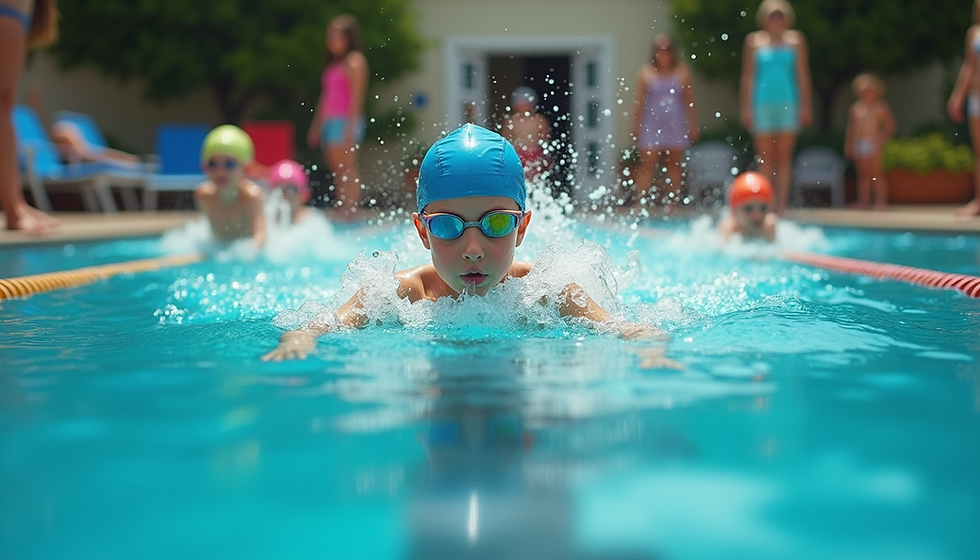
Clementine practicing her dives
Last week I did something small. I asked a question about swimming in an online group for parents of kids with ADHD. It was the kind of question you ask when you're pretty sure you already know the answer, but you need to hear it from someone besides yourself.
Three years ago, my daughter joined a swim team, and it changed things for her more than we ever expected. The sleep. The focus. The friendships. The calm. I had watched it happen in my own house for three years, but our experience felt like ours alone. So I asked: has anyone else seen something like this?
What they told me, together, is one of the most remarkable things I've come across since I became interested in this topic.
One Word Kept Showing Up
Here's the funny thing about my question. It mentioned sleep, focus, and friendship. It never mentioned regulation. And honestly, that was my oversight. Outside of sleeping through the night, regulation has been the most important change for my own daughter. I had just lived with it so long, I forgot to name it.
The parents named it for me. That word, regulation, or its everyday cousin, calm, showed up more than sixty times. Unprompted. From parents who have never met each other. Mothers in Texas and the UK and South Africa, describing the same thing in nearly the same words: the water settles their child in a way nothing on land does.
Their theories were remarkably consistent too. The pressure of the water. The rhythm. The muffled sound. The repetition. Two occupational therapists happened to be in the thread, and they confirmed what the parents had discovered on their own. Deep pressure. Rhythmic movement. The kind of sensory input these kids' bodies are hungry for. One of them wrote that swimming “levels the playing field” for clumsy, low-tone, neurodivergent kids.
These families had found therapy by accident. It was in the pool the whole time.
Since that first post, I've asked a version of this question twice more, in smaller groups. The same word came back both times, again with nobody prompting it. Regulation. Calm. It isn't one board, or one algorithm. It's the water.
What the Kids Told Their Parents
The parents' and children's stories moved me.
One mom shared what her ten-year-old son told her: “I love swimming because after my dive, it's just me and the water. I can't really hear any of the yelling or cheering. I focus.”
Another mom asked her nine-year-old daughter what she thinks about while swimming length after length after length. Her answer: “Nothing.” Her mom's reflection stayed with me. What a gift that must be, for a brain that never gets a break.
A third parent's daughter put it this way: “My brain feels less busy when I swim.”
Three children who have never met. One sentence between them: the water quiets the noise.
The Stories Behind the Stories
Sleep came up again and again. One family's nightly melatonin dropped to a couple of nights a week during swim season. Focus, friendship, and confidence each showed up in dozens of responses. Several parents mentioned, carefully and without anyone asking, that their children seemed to need less medication support during swim season. That's not something I would ever suggest a family change without their doctor, but the pattern was too consistent to leave out.
Roughly ten families told me their swimmers went on to swim in college. One of them is a young man with both autism and ADHD. His mother said swimming changed his whole life, and he's competing on a college team today.
And one story really stood out to me. A boy with ADHD and Tourette's whose tics all but disappear during swim season, so his family swims year-round now. This is a kid who needed a one-on-one aide in kindergarten. Today he's taking AP classes and working as a teaching assistant at swim lessons, helping little kids learn the thing that changed his life.
Then there's the part I didn't see coming. More than twenty adults answered not about their children, but about themselves. Grown men and women with ADHD who said swimming was the thing that carried them through childhood. One called the pool her safe place, age 7 to 18. Another remembered her school days as a girl: swimming before school, a swim class midday, swim team in season. She always did better in school, she said, when she swam a couple hours a day.
One mom, diagnosed with ADHD as an adult after swimming D1 in college, wrote about both of her daughters. One plays softball and loves it, but it doesn't calm her in the way swimming does. Sometimes it does the opposite. The water is the only place that consistently brings her daughter down.
But the stories that stayed with me longest were the ones where it was both. A parent with ADHD and a child with ADHD, in the same house, both finding the same answer in the water. Mothers who swam through their own childhoods, now standing on a pool deck watching it work again. The same brain, the same struggle, the same quiet solution, a generation apart.
What moved me most wasn't the numbers. It was the vulnerability. These parents didn't share their families' hardest chapters for sympathy. Reading their words, it was clear they were telling their stories for one reason: the hope that some other family, somewhere, might struggle a little less because of it.
The Part Nobody Talks About
Not every story was a success story. I want to tell those too, because I think they may matter most.
Kids who loved the water but couldn't bear the noise and the watching eyes of swim meets. A boy who quit after one practice because he couldn't stand being told what to do. Children who swam for years but never progressed, because standard stroke instruction assumes a coordination their bodies don't have, and nobody adapted it for them.
And plenty of families found their answer somewhere else entirely. Hockey. Gymnastics. Horseback riding. Martial arts. Dance. Water polo. Even skateboarding and scouting. For those kids, it wasn't the water. It was movement, rhythm, and a place to belong.
And running underneath everything, a quieter chorus presented itself. We can't find a team near us. We can't find a coach who understands our kid. Our season ends in three weeks and I'm scared of what comes after. One mom, whose kids left gymnastics, put it in a single sentence: the coaches had no patience for regulating ADHD kids.
That's the finding under the finding. A thousand parents lit up about what the water gives their children, and woven all through their joy was the same frustration. The benefit is proven. The access is missing. And who the coach is matters. Over and over, it was the difference between a kid who quit after one practice and a kid whose whole life changed.
That gap is why Headwater Athletics exists. After reading those responses, I have never been more certain of it.
The Swim Board Said The Same Thing
I asked a version of the same question somewhere else, too. The Swim Parent Facebook group, not one built around ADHD lke the first. I still named my daughter's diagnosis in the question and asked directly for other neurodivergent families and swimmers to weigh in.
The answers came from a smaller room. Fifty-three comments, thirty-three reactions, one share. But the pattern held.
One dad has watched his son swim since he was eighteen months old. His son is seventeen now, and has ADHD. Sixteen years later, the boy has never really stopped swimming. His parents can tell within a day when he's missed practice. He just feels a little heavier out of the water.
And one comment put words to something I'd felt but never said out loud. Your race is yours. Nobody's waiting on you to make the catch or take the shot. But your time still counts for the team, and in a relay, your leg is part of something bigger. It's belonging, without the pressure of carrying the whole play.
Then a two-time Olympic swim medalist Nick Thoman, showed up with a comment. He put it simply: "My autism helped me win two Olympic medals."
Where This Goes From Here
I'll be honest. When I posted my question, the idea of writing a series didn't exist. I expected ten or twelve replies. It was only when the responses kept coming, when I found myself reading story after story, that I felt called to write about this.
So that's what I'm going to do. Over the coming months, I'll be gathering stories and running a series here about the impact of swimming on kids and adults with ADHD, dyslexia, and anxiety. The transformations. The honest struggles. The long arcs from a first terrified lesson to a college pool deck. That generosity I saw in those thousand responses, parents helping parents, is what this series will be built on.
If you have a story you believe could help another family struggling to help their child, please reach out. I would truly love to hear it. Your story could change another person's life, the way swimming changed my daughter's.
The research has told me swimming helps kids. A thousand parents just told me something bigger: all over the world, families are discovering the same quiet miracle, mostly alone, mostly by accident, waiting for someone to build the door they keep looking for.
We're building it.
This post is for informational purposes and does not constitute clinical advice.
If this resonated, there’s more.
Posts like this arrive every two to three weeks — reflections on raising children with ADHD and learning differences, the science behind what helps, and what’s being built at Headwater Athletics. Hit the below button and join!

Comments