

Why the Pool May Be the Best Place Your Child Makes a Friend

Updated: Jul 26

How structured swim programs help kids build and keep real friendships PLUS a Q&A with Sherry Lewis, LPC
Ask the Expert | Headwater Athletics | May 2026
For many children struggling with focus, anxiety, or social confidence, friendship doesn't come easily. The classroom can feel overwhelming. Recess can feel like a social minefield. Birthday parties, group projects, team sports with scoreboards and pressure can make a child who already feels different retreat further into themselves.
But something interesting happens when you put that same child in a pool — especially when the environment around them holds space for who they are, meets them where they are, and celebrates what's right with them rather than cataloguing what isn't. It's what we built Headwater Athletics around, and what the research tells us, again and again, happens when the right environment meets the right kid.
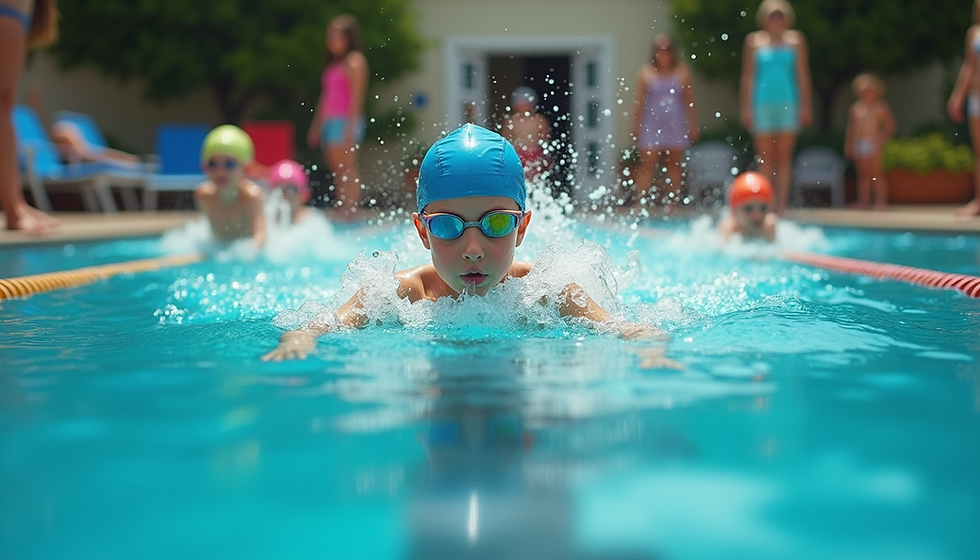
Kids who arrived quiet and uncertain leave chatting with a teammate. Kids who struggled to make eye contact are smiling across the lane. And by week three or four of a nine-week program, genuine friendships have taken root — they last well beyond the pool.

Why Swimming Creates a Different Social Environment
Most team sports are built around competition, performance, and comparison. Someone wins. Someone loses. Someone sits the bench. For a child who already feels behind academically, socially, or emotionally, those dynamics can reinforce exactly the feelings of inadequacy they're trying to escape.
But the environment surrounding a child in sport turns out to matter enormously — perhaps more than the sport itself. Research consistently shows that interpersonal factors, including the influence of coaches, teammates, and peers, are among the most important variables in whether sports participation helps or hurts a child's sense of self and belonging. Coaches have been shown to influence athletes' motivation, beliefs, and enjoyment, and to shape whether a child develops a desire for challenge and mastery or quietly retreats from both.
At Headwater Athletics, we have created an environment that allows your child to open up and connect. This is why the structure of the program — and the culture inside it — matter as much as the water itself.
Swimming at the beginner level offers something rare: there is no opponent standing across from your child. No crowd watching. No scoreboard during practice. Just a lane, a goal, and a coach who leads from the heart — and the chance to improve against yesterday's self, not against anyone else. That shift alone changes what's possible socially. Research on children with ADHD has found that physical activity programs that allow for continuous positive emotional feedback during exercise are significantly more effective at improving both confidence and emotional regulation. A pool, with its clear, measurable, personal progress, delivers exactly that.
That environment lowers the stakes just enough for something remarkable to happen: kids relax. And when kids relax, they open up. And when they open up, they connect.
Researchers at the University of Oxford found that children who moved in sync with one another during play showed significantly more cooperative and prosocial behavior toward each other. Swimming, stroke after stroke, lap after lap, may be one of the purest forms of that synchrony. When two kids go through something challenging together (including something as simple as learning to breathe properly through a flip turn), they form a bond that pure conversation rarely creates as quickly. The pool gives children a shared struggle, a shared victory, and a shared language.

Small Groups Change Everything
At Headwater, our sessions are intentionally capped at ten children with only five per lane. That's not just a coaching decision; it's a friendship decision.
In a group of ten, no child is invisible. There is no back row to disappear into. There is no lunch table with forty kids where you can sit alone unnoticed. Every child is seen by the coach and, crucially, seen by their peers. There are no favorites. Every child is seen. That commitment to a loving, equitable environment inside the pool is foundational to everything that happens there.
Small groups also mean that kids interact with the same people week after week, session after session. Consistency is the ingredient most friendship-building programs miss. You can't manufacture belonging in a single afternoon. But nine weeks of showing up to the same pool, with the same kids, working toward the same goals? That's enough time for inside jokes to develop. For nicknames to stick. For one kid to notice that another kid had a hard day and say something about it.
That's friendship. And it can start in the pool.

The Equalizer in the Water
One of the most powerful things about a swim program for kids with ADHD, learning differences, or anxiety is that the water doesn't know their diagnosis. It doesn't know their reading level. It doesn't know that they got pulled out of class for extra help or that they had a meltdown last Tuesday.
The pool is a clean slate.
A child who feels perpetually behind in school can be the first one to nail a new drill. A child who struggles to sit still is suddenly the most comfortable person in the room — because the room is a pool, and movement is the whole point. The kid who feels invisible in a classroom can be the one who helps a nervous newcomer figure out their goggles.
These small reversals matter enormously. They shift how a child sees themselves and how their peers see them. And when a child is seen differently by their peers, the social calculus changes. Friendship becomes possible in a way it maybe wasn't before.
The pool did that. The structure did that. The heart-led environment did that — where every child is seen and there are no favorites. The small group, the consistent schedule, the coach who cares created the conditions for something that can't be forced or scheduled.
Real friendship found a way in.
A Conversation with Sherry Lewis, LPC
Licensed Professional Counselor, Success Strategies 4 Kids
Friendship, Feelings, Family: Skills for Life!
303-915-4421 www.ss4k.com

On friendship, belonging, and what kids actually need.
We asked Sherry Lewis, Licensed Professional Counselor at Success Strategies 4 Kids, to share her perspective on the science and heart behind what happens when children find their footing socially.
Here's what she had to say.
The Pool as a Clean Slate
Q: The blog describes the pool as a "clean slate" — a place where a child's diagnosis, reading level, and classroom struggles simply don't follow them in. From a therapeutic standpoint, how do you think about the role of these identity-reset environments in a child's social development? And how do we help a child carry that version of themselves into settings where the slate isn't as clean?
A: One of the first things I do is challenge the stories kids carry about themselves. Not because they're wrong, but because they're almost always incomplete. A child who has been struggling socially has often heard, directly or indirectly, that something about them is the problem. They start to believe it. And they walk into rooms bracing for it to be confirmed.
The pool interrupts that. The water doesn't know the story. The coach doesn't know it. The kid in the next lane doesn't know it. When there's nothing to brace against, the nervous system can finally relax — and that's when connection becomes available. Relaxed kids open up. Open kids connect.
The harder work is transfer. A child can feel completely different in the pool and slip back into the old story by the next day. What I've found bridges it is naming — specific and in the moment. Not "good job" — something like "I noticed you helped that kid figure out the flip turn." You're handing the child a piece of new evidence to hold alongside the old story. Do that enough times, and the new story starts to take hold. But it has to be named. Kids don't carry forward experiences that no one helped them keep.
Small Reversals and Internalizing Wins
Q: The blog talks about "small reversals" — moments where a child who usually feels behind is suddenly the first to nail a new drill, or the one who helps a nervous newcomer. What does it mean therapeutically when a child gets to be the capable one? How do we make sure they are internalizing those moments rather than letting them pass? And what is one small thing a parent can do at home to help a child name and celebrate those wins?
A: These moments are gold — and they can disappear if no one catches them.
Children who have struggled socially have often learned not to trust good moments. They minimize them or wait for them to be taken away. The shift — "I am someone who helps, I am capable" — doesn't happen automatically. At first, someone on the outside must do the catching.
A tool I give parents is one question. At the end of each session, ask your child: "Was there a moment today where you surprised yourself?" Not "did you have fun." Not "were you the best." Just: did you surprise yourself? That question teaches a child to scan their experience for what went right instead of what went wrong. Ask it consistently, and eventually they start doing it on their own. That's the shift you're watching for.
What Parents Can Do — Quietly
Q: The blog points to consistency (nine weeks, same kids, same pool) as the ingredient most friendship-building programs miss. Are there things you love to see parents do, woven quietly into daily life, that help children build and keep friendships without it ever feeling like a lesson or a correction?
A: When friendship becomes a lesson or a project, kids feel watched. And that's the opposite of the conditions that let real connection happen.
What helps is to create low-pressure repetition. Not playdates that feel like an assignment, but small, regular contact with the same kids. A neighbor you wave to every morning. The same activity, week after week, with the same group. Belonging doesn't happen in a single afternoon; it accumulates through ordinary, repeated contact.
One effective tool is the drive home. Not "how was it?" (You'll only get a shrug.) Try: "Was there anyone you talked to today?" or "Did anything funny happen?" You're not managing the friendship. You're teaching your child to notice their own social world. That habit builds over time. And when it's hard, resist the urge to rescue. Social confidence grows from navigating, not from being spared.
What's Actually Driving the Shift
Q: Children are making friends more easily in structured programs like this and keeping them. From where you sit, what do you think is actually driving that shift? And what should parents be watching for to make sure it holds as children move into new environments, new grades, new teams?
A: The honest answer is safety — a very specific kind of safety. Not physical safety. Safety from comparison.
Most environments are quietly organized around ranking. Who reads faster. Who gets picked first. Who already has the most friends. That kind of pressure is exhausting, and it makes real connection difficult because a child who is busy managing that pressure can't quite see the person next to them.
Remove the comparison, and kids can look up from managing themselves to notice others. And that's when friendship is possible.
I'd reframe "making friends more easily" as learning to trust themselves more — their instincts, their timing, their read of a situation. That's not a skill you can measure. It's a growing confidence in their own social sense. When that confidence builds, connection follows.
Watch for when your child starts saying a name. Early in a program, they may not mention anyone at all. When you hear "there's this kid Marco who is so funny," that's the marker. A child with no names to offer is still inside their own head. A child with a name has started to actually see someone else.
What carries it forward is new observations, wondering questions in new settings. Not "did you make friends?" — but noticing what happened, what felt good, what worked well. Keep naming what you see. Keep asking the questions. A new story about oneself needs consistent reinforcement until it can stand on its own.
Please consult a qualified professional for evaluation and treatment recommendations specific to your child.
Your child's focus is not out of reach. Sign up for our newsletter to receive information about our upcoming clinics and programs.

Comments