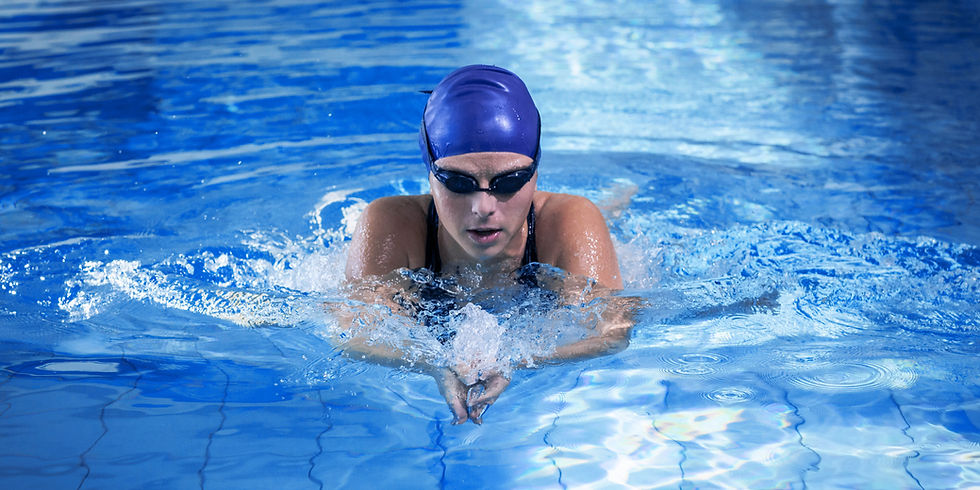

Why Water Works: How Swimming Helps Kids with ADHD, Anxiety, and Dyslexia

Updated: Jul 6
Research Says | Headwater Athletics | April 2026
If your child struggles to sit still, calm their racing mind, or falls apart on their way to school, you already know how exhausting it can be for them and for you. You've tried every strategy the teachers suggested. You've sat through evaluations. You've read the books. You've tried supplements. And yet, some mornings still feel impossible.
What if one of the most powerful tools for helping your child focus, feel calmer, and build confidence is found in a swimming pool?
Research published over the past two years is painting an increasingly clear picture: for children with ADHD, anxiety, and dyslexia, swimming isn't just good exercise. It's a neurological reset button.

What Happens in a Child's Brain During Swimming
Before diving into the specific conditions, it helps to understand why swimming is uniquely effective not just as exercise, but as a brain intervention.
At Headwater Athletics, we get it! Our coaches have tons of experience working with neurodiverse children. The results are that our kids have markedly improved with their heart-led approach and tried-and-true methods.
When a child swims, several things happen at once. The repetitive, rhythmic motion of strokes activates the brain's motor pathways and promotes focus in ways that chaotic, unpredictable activities don't. The water itself provides constant sensory feedback — pressure, temperature, and resistance — that helps the nervous system self-regulate. The breathing required in swimming (exhaling underwater, inhaling above) directly stimulates the autonomic nervous system, which controls the body's stress response.
A 2025 study published in Frontiers in Psychology confirmed that the rhythmic breathing patterns required in swimming help regulate the autonomic nervous system, reducing anxiety, while the immersive water environment minimizes external distractions and enhances psychological relaxation. In other words, the pool is doing something a classroom simply cannot: it is physically quieting the nervous system while demanding focused, patterned movement.

Swimming and ADHD: A Natural Fit for an Active Brain
ADHD is one of the most common neurodevelopmental conditions in childhood. Kids with ADHD often struggle with impulse control, staying on task, emotional regulation, and transitions. Traditional interventions like medication and behavioral therapy are helpful — but parents are increasingly looking for complementary approaches, like Headwater Athletics' 9-Week Swim Program that gives their child's brain what it craves: movement, stimulation, and immediate feedback.
Swimming delivers all three in a structured, predictable environment.
A 2024 research review published in Multidisciplinary Science Journal found that adaptive swimming benefits brain function, behavior, and academic outcomes in children with ADHD, concluding that practitioners may be able to use these findings as early evidence in favor of alternative treatment methods.
That tracks with a well-cited randomized trial that followed 40 school-age children (ages 9-12) diagnosed with ADHD. After just 12 weeks of adapted swimming three times per week, researchers found significant improvements in behavior, inhibition process (the ability to stop and think before acting), and academic performance, all compared to a control group that did not swim.
For parents, the words "academic performance" are not abstract. They mean your child sitting in class more calmly, processing instructions more readily, and producing schoolwork more consistently. Children who are calmer and more regulated find it easier to build and maintain friendships. Swimming sets them up for success.
Swimming also uniquely benefits kids with ADHD because it is non-competitive at beginner and intermediate levels, allowing children to progress at their own pace without the social pressure that can derail focus. The environment is predictable — same pool, same lane, same routine — which is exactly the kind of consistency an ADHD brain craves. The water itself provides natural resistance, offering the deep proprioceptive (body awareness) input that many children with ADHD need to feel grounded.

Swimming and Anxiety: Calming a Worried Child from the Inside Out
Anxiety in children often looks like avoidance. It's the child who refuses to go to school or can't fall asleep because their mind won't stop. Anxiety and ADHD frequently co-occur, but many children carry anxiety without any other diagnosis, and they're struggling just as much.
A 2025 survey by Swim England found that 8 in 10 working parents believe swimming lessons helped reduce their child's stress or anxiety, underlining the role that time in the water can play in supporting children's emotional wellbeing. Nearly 8 in 10 parents also said that swimming lessons improved their child's concentration and attention span; benefits that carried directly into the classroom.
The neurological explanation for this is not complicated: swimming triggers the release of endorphins (the brain's natural mood-lifters), reduces cortisol (the stress hormone), and promotes deep, regulated breathing, all of which directly counteract the physical symptoms of anxiety.
What makes swimming especially powerful for anxious children is the sensory environment itself. Abbey Neuropsychology Clinic notes that the feeling of water on the skin, the sound of splashing, and the repetitive motion of strokes all contribute to sensory integration, helping children with anxiety build a calmer, more organized nervous system over time. Many children who struggle with overwhelming sensory environments at school find the pool paradoxically soothing, because the sensory input is consistent and enveloping rather than unpredictable and jarring.
For children with anxiety, swimming also builds something harder to measure but just as important: courage. Getting in the water, putting their face under, and learning a new stroke are small, concrete victories. Each one teaches a worried child that they can face something scary and come out okay on the other side.

Swimming and Dyslexia: Building the Whole Child
Dyslexia is a neurobiological learning difference that affects how children process written language. Children with dyslexia are often bright, if not gifted, creative, and capable, but the daily grind of school can be deeply demoralizing. Feeling behind, being pulled out of class for extra help, and watching peers read effortlessly can erode a child's sense of self in ways that outlast the reading struggles themselves.
This is where swimming plays a role that goes beyond the neurological and into the deeply personal.
Research consistently shows that regular physical activity improves concentration, focus, and mood, while relieving the kind of stress that accumulates in a child who is working twice as hard as everyone else just to get through a reading assignment. For a child with dyslexia, that stress relief is not a luxury; it is a lifeline that makes the academic work possible.
Yale's Dyslexia program has highlighted powerful examples of how swimming builds the executive skills and self-belief that transfer back to the classroom. One mother described watching her daughter, a state-ranked swimmer, make the connection between focused effort in the pool and improved performance at school. Her daughter went from the lowest reading group to the highest over four years, and she credits the discipline and confidence she built in the water. Swimming gave her daughter an identity not rooted in struggle, but in strength.
According to Swim Angelfish, a leading adaptive aquatics program, at least 1 in 5 children have learning or thinking differences such as ADHD or dyslexia, and aquatic therapy can help improve a child's sensory needs, strength, coordination, and motor planning in ways that support functioning across all environments. The structured, multi-sensory nature of swim instruction — including listening to a coach, feeling the water, watching a demonstration, then executing a movement — actually mirrors many of the multi-modal learning strategies that help dyslexic children succeed in the classroom.
And in the pool, the rules are clear. The lanes are marked. Success is measured in small, visible increments — a personal best, a cleaner stroke, a full lap without stopping. For a child who may feel invisible in a reading group, those concrete wins are transformational, and those are the victories we celebrate at Headwater Athletics.

What the Research Tells Us to Expect
If you're wondering what a realistic timeline looks like, the research offers guidance. The most rigorous studies used 12-week programs, with swimming sessions three times per week for 45-60 minutes. Within that timeframe, parents and teachers reported meaningful improvements in:
Behavior and impulse control
Ability to follow instructions
Mood stability and emotional regulation
Academic performance (particularly in reading and math)
Anxiety and depression symptom scores
Self-esteem and social confidence
These are not minor lifestyle improvements. Parents of children with ADHD, anxiety, and dyslexia often spend significant time, energy, and money searching for solutions — whether that's tutoring, therapy, or medication adjustments.
Swimming doesn't replace those supports — but it makes all of them work better, because a regulated, confident, physically active child is better able to absorb everything else you're offering them.

How Headwater Athletics Can Help
At Headwater Athletics, we understand that focus, attention, and emotional regulation are not just school problems; they are whole-child challenges that affect your family's daily life. We work with children who struggle with ADHD, anxiety, dyslexia, and related conditions, using a heart-led, evidence-informed approach designed to address the underlying patterns, and not just manage symptoms. We take great effort in creating an environment that helps children form and build friendships.
Whether your child is newly diagnosed or has been struggling for years, we can partner with you to build an experience that supports their brain, their confidence, and their future. From structured sport instruction to executive functioning development, our team is here to help your child find their stride.
This blog is for informational purposes only and does not constitute medical or clinical advice. Please consult a qualified professional for evaluation and treatment recommendations specific to your child.
Your child's focus is not out of reach. Sign up for our newsletter to receive information about our upcoming clinics and programs.
Sources for this Article
Wang, Yu, Huang & Gao (2025). Mechanisms of the impact of exercise intervention on college students' mental health: a longitudinal experimental study using swimming as an example. Frontiers in Psychology. doi: 10.3389/fpsyg.2025.1535214
Marwaha et al. (2024). Investigation on the impact of swimming on children with ADHD. Multidisciplinary Science Journal, 6, e2024ss0618.
Hattabi et al. (2022/2024 review). A Randomized Trial of a Swimming-Based Alternative Treatment for Children with Attention Deficit Hyperactivity Disorder. International Journal of Environmental Research and Public Health, 19(23), 16238. doi: 10.3390/ijerph192316238
WE Aquatics (June 2025). Why Swimming Lessons Benefit Kids with ADHD. weaquatics.com
Swim England (September 2025). How swimming lessons benefit children beyond the pool. swimming.org / #LoveSwimming Campaign, Wave 16.
Abbey Neuropsychology Clinic (October 2025). Water Wonders: Benefits of Swimming for Children with ADHD. abbeyneuropsychologyclinic.com
One with the Water (updated 2025). Swimming and Dyslexia: Powerful Partners. onewiththewater.org
Yale Dyslexia (2024). Sports: Strengthening Self Confidence and School Skills. dyslexia.yale.edu
Swim Angelfish (May 2025). Learning Disabilities & Swimming: Aquatic Therapy & Swim Lessons. swimangelfish.com

Comments