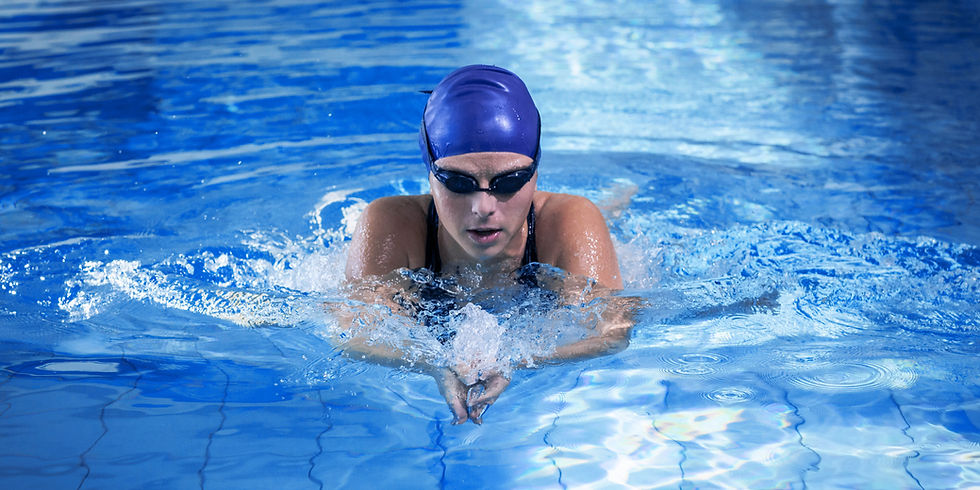

Meet Coach Skyler: The Calm Behind the Chaos

Updated: Aug 27
A Rise & Swim Coach Q&A
Skyler Findley has been swimming since he was nine years old, and just wrapped up
his sixteenth and final summer coaching the same club team he grew up on. He now
coaches with Boulder Swim Team — and it was his own boss there who first connected him to Headwater Athletics, after Becky reached out looking for a coach and got pointed
straight to Skyler’s bio: “Skyler’s your guy. This is right up his alley.” The two met for coffee, and it went from there.
Skyler's older brother, Greyson, is autistic. The two of them had done taekwondo together as kids, but swimming was usually split up by age and skill level — so when their parents tried to sign up just one of them, a local coach said no. Both boys were welcome, he told them, and it didn't matter that Skyler was nine and had never swum on a team before. That early lesson — that every kid deserves a lane, not just the fast ones — has shaped the way Skyler coaches ever since.
We sat down with Skyler to talk about what day one looks like for our Rise & Swim swimmers, how he balances technique with confidence, and why the water has always
been his own calm place, too.

What got you into coaching in the first place?
Nathan Phillips is someone I've got to give credit for getting me inspired to coach. I'd transferred high schools, and he was organizing the middle school program. He just walked up to me and said, "Skyler, you're going to coach middle schoolers with me this year." I was fifteen years old. He'd worked really hard to create programs for public school kids to have access to school swimming, because in Nashville that just wasn't a thing, and those kids didn't have access. He pushed me to start coaching, and he was fantastic — one of my biggest coaching influences.
What’s your game plan for day one?
I think it’s important for a coach to have more than one philosophy, depending on who’s in front of you. A group of ten-and-unders who’ve been winning everything in summer league needs something different than a group of kids who’ve never been on a team and don’t really want to talk to each other yet.
For Rise & Swim, my vision is to build in a lot of social interaction and treat the swimming
almost like active recovery — the “main set” is really about talking to your lane buddy and
playing games together.
Day one, we’ll open with something like Mind Meld — a camp game where two people
count down and say a word at the same time, trying to land on the same one. It sounds
simple, but it gets kids laughing and paying attention to each other right away. From there we’ll move to some easy kicking sets on an interval, where I’ll have kids read the pace clock, tell their lane neighbor their time, and eventually set a goal time for their buddy. If a kid doesn’t know how to use the clock, the other kids in the lane will teach them faster than I ever could standing over their shoulder. We’ll close out with some torpedoes off the wall —or “rockets,” depending who you ask — just seeing how far they can glide.
How do you balance technical skill with confidence?
I think focus comes from repetition of the skill itself — you’re not really teaching someone “how to focus,” you’re teaching them the skill, and if they’re interested and challenged in the right way, the focus follows. Confidence is the real key, and that comes from a lot of small adjustments in every single interaction.
If you’re so fixated on technique that you never let a kid fail, or you correct them the second they do, some kids shut down. They start wondering why you won’t just let them swim. The foundation of building confidence is allowing kids to fail, and then either coaching them through figuring it out themselves, or — if they’re overwhelmed — helping them find the next small step forward.
I actually wrote this quote down recently, and it’s stuck with me: it is impossible to learn —or do — that which you think you already know. Sometimes a kid needs a catalyst, a moment that makes them realize what they thought they knew, they didn’t quite have yet. Getting out and competing, and sometimes struggling, is often exactly that catalyst.
Do you have a success story that stands out?
There’s a girl I’ve coached for two years now — I won’t use her name. She started in my
group at eleven years old as one of the smallest and slower swimmers. She wanted, badly, to be the best swimmer in the pool, and when she’d miss a goal time during a hard set, she’d stop at the wall and just break down crying.
I learned to be careful with that. I wasn’t going to swim over and tell her it was okay —
obviously it wasn’t okay to her in that moment, and it wasn’t my place to say so. So we
talked, a lot, after practice: here’s what we do the next time this happens, here’s where we
go from here. Long before we ever talked about goal times, I told her, “I’m going to keep
giving you sets where you’re going to fail. That’s my job. When that happens, how do you
handle it?”
Fast forward about a year and a half, and she’s the best trainer in the group. Last season,
during a tough set, I watched her miss her goal time four times in a row and get visibly
frustrated — but I could also see the other girls in her lane noticing. I stepped back and
didn’t say anything. They started coming over between reps, encouraging her, and she
rallied through the rest of the set. That’s the kind of thing you can’t coach directly — you
can only build the conditions for it. We do training logbooks a couple times a week with
that group, and that day everyone wrote about something a teammate did to help them.
A lot of kids coming to Rise & Swim aren't competitive swimmers. What do you want their parents to know about how you'll show up for their kid.
I will remember your name, what pets you have, what you love and hate about school and swimming, and I will be your biggest fan and supporter.
I will teach you how to handle failure and recognize success in the pool.
I will encourage you often to share your successes and failures with your teammates.
And most importantly, you will learn that it's better to try and fail than to not try at all.
Have you felt the calming effect of the water yourself?
Absolutely. As a kid, one of my favorite games was Gator — like sharks and minnows, but
you had to pull someone all the way to the surface to tag them; it didn’t count underwater. It was part tag, part wrestling match, part breath-holding contest. My happy place, honestly, was the bottom of the diving well, where you can’t hear anything — total sensory deprivation, just floating while everyone tries to grab you and pull you up. I’ve always had a pretty good breath hold.
Quick-fire round
Favorite stroke? Breaststroke — I was just a natural at it.
Pre-race ritual? Visualization. I’d always picture the race before I swam it. (Fun fact:
visualization is an executive functioning exercise — you can teach a kid to do it in about ten minutes.)
Favorite meal? Tacos.
Other sports you play? Ultimate Frisbee and soccer.
Favorite animal? The otter.
Favorite candy? Nerds Gummy Clusters, specifically.
Favorite book? Holes by Louis Sachar.
Favorite band right now? Steely Dan
A fun fact people don’t know about you? I’m a serious chocolate lover — my ideal ice
cream is chocolate, with more chocolate, and bits of chocolate in it. Also, my dad was a
professional trumpet player, and my mom, Gerri Findley, is a graphic designer turned fine
artist.
If you could swim anywhere in the world? Okinawa, Japan — I went surfing there this
year and loved it. Second choice: the Seven Hills pool back home, where I learned to swim.
_________________________________________________________________________
“I’ve been around swimming for a long time, and I’m really passionate about trying to create the experience that I’ve had through swimming — for other people.”
— Skyler Findley
Registration for Rise & Swim is open now. If your child needs a calm, confident start to the day — whether that’s ADHD, anxiety, dyslexia, a learning difference, or simply a kid who does better in the water — we’d love to have them in the pool with Coach Skyler.


Comments